Yakistan Imperial IPA

Going for a big freakin’ IPA this time. Yakistan Imperial IPA
For a 5 gallon batch, partial-mash.
Estimated OG: 1.082
Estimated IBU: 88
Estimated ABV: 8.3%

grain

  • 10.0 lbs LME
  • 1.0 lbs Munich
  • 1.0 lbs Crystal 10L
  • 0.5 lbs CaraPils

hops

  • 1.0 oz Centennial (10% alpha) 60 minutes
  • 1.0 oz Centennial (10% alpha) 45 minutes
  • 1.0 oz Centennial (10% alpha) 20 minutes
  • 1.0 oz Crystal (3.9% alpha) 10 minutes
  • 1.0 oz Crystal (3.9% alpha) 5 minutes

misc.

  • California Ale Yeast (WLP 0001)
  • Irish Moss

Qbrew data for 2005 hops

One of the wonderful things about QBrew is that you can edit your own config files. The qbrewdata file is simple XML and you can add ingredients, change IBUs, add styles, etc. I did this last year because the IBUs on the hops differed from my stock (and they differ year to year).

This year I’ve again updated the IBUs on my hop list, as well as added a few varieties that weren’t on the list. I also added my most frequent yeast, California Ale. Lastly, I added an Imperial IPA category to the list using the BJCP style guidelines for that newly recognized style.

I doubt you’ve any interest in my changes, but here’s a copy of my qbrewdata. Just remove the .xml and put it into the same folder as your application and you’re set.

usually C:\Program Files\qbrew\ on windows, and mac/linux users are smart enough to figure that out on their own since its a more involved installation.

The Teacher

I’m going to be introducing brewing to some friends and I’ve done it enough times that I think I’ve got hand of it. But when I’m “teaching” I tend to speak (and think) faster and often less contiguously than is proper when teaching. Add to that a beer, or two, I wonder what I forget. I’m just curious what lessons about brewing people have found the most helpful, or wish they’d learned earlier? I’d like to know.

Old Kegerator Plans

old hand-drawn kegerator plan

I stumbled upon an old work training packed from early in my employment. I had doodled all over the back of it with plans for a kegerator – including this one, which is astoundingly accurate. The picture even includes the BLC bottle and hop packets on the door. It looks and functions quite similar to my existing kegerator though I’ve only lagered a single beer since its christening. That reminds me though – I need to make a lager. Or a Pils. Mmm…. pilsner….

Sumerian Beer – Ninkasi before Bread?

I’m trying to find something on an old myth about a town under siege that decides to brew beer instead of making bread because it was the most efficient use of the grain. My dad and I were recently discussing the myth and couldn’t figure out why they would have made the choice and to what advantage brewing would be. Anyway, I’m still looking for it, but I did find an interesting article about the possibility that beer (or ninkasi) may have prompted early hunter-gatherers to domesticate rather than bread. The Sumerians had a lot of beer-related tradition and law, so its really an interesting, if unanswered question. One interesting revelation:

When the “Hymn to Ninkasi” was written, beer was made using bread. But bappir, the Sumerian bread, could be kept for long periods of time without spoiling, and so it was a storable resource. We also know, from various annotations on bappir and beer in the Sumerian and Akkadian dictionaries, that bappir was eaten only during food shortages. In essence, making bread was a convenient way to store the raw materials for brewing beer.

How peculiar.

End of keg foam

Even when you know that its coming, the last sputtering of foam from a dead keg is still kind of a surprise. It could also be a disappointment if I didn’t know about a certain keg of stout waiting to be tapped.

Taste of Bitter, Taste of Stout

Today I kegged the Stout. It was in secondary for 2 weeks because I’m in no hurry to drink it. Regardless, I decided it could age further while carbonated and chilled – safe from evil spirits. The sample I took to take the final gravity (only 1.018 – a little high, but expected considering all the grain) provided an ample preview of things to come. Its delicious, and the best comparison I can think of for friends is pikof and dropof from Hales. Its dark, chocolately and smooth. But not imperial.

The bitter is quite nice too. Authentic in flavor with a slightly hard water dryness to it. Mild in hop and flavor but a great session beer. On tap now.

ASB kegged, Stout in secondary

Yesterday I kegged the Bitter and it’s really quite spot on for flavor and bitterness – even a bit of the fruity affects that make a good British pint good. The final number: 1.012! We’ll see how it carbonates though. I’m trying out a new kegging stone that is supposed to more easily diffuse CO2 into solution. Here’s hoping.

The stout on the other hand is probably more chocolate than I’ve ever done before. Its quite nice right after primary but is only at 1.020, so its got some room to drop. Luckily there was a bit of activity at the airlock last night so maybe its working on those sugars some more.

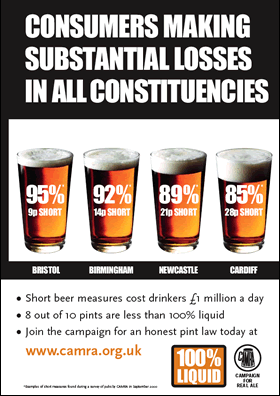
CAMRA lobbies for full pints

full pints!

The Campaign for Real Ales (CAMRA) is sponsoring a forum in which to ask your MP (representative) to reject legislation from the pub industry (many closely tied to the brewers themselves) that would define a pint as no less that 95% of a pint (or 16 oz).

The page also includes a full pints calculator to determine how much money you’ve been cheated out of depending upon your average pints of ale or lager consumed per week.

I love CAMRA and their reactionary fight to protect the sanctity of ales in the UK. But I don’t think their membership would fare as well here since so much of our beer consumption is in bottled form. I’m hoping that’s something we’ll be able to change in our own lives, even if those real ales are just my own.