Even when you know that its coming, the last sputtering of foam from a dead keg is still kind of a surprise. It could also be a disappointment if I didn’t know about a certain keg of stout waiting to be tapped.
Category: Homebrew
Taste of Bitter, Taste of Stout
Today I kegged the Stout. It was in secondary for 2 weeks because I’m in no hurry to drink it. Regardless, I decided it could age further while carbonated and chilled – safe from evil spirits. The sample I took to take the final gravity (only 1.018 – a little high, but expected considering all the grain) provided an ample preview of things to come. Its delicious, and the best comparison I can think of for friends is pikof and dropof from Hales. Its dark, chocolately and smooth. But not imperial.
The bitter is quite nice too. Authentic in flavor with a slightly hard water dryness to it. Mild in hop and flavor but a great session beer. On tap now.
ASB kegged, Stout in secondary
Yesterday I kegged the Bitter and it’s really quite spot on for flavor and bitterness – even a bit of the fruity affects that make a good British pint good. The final number: 1.012! We’ll see how it carbonates though. I’m trying out a new kegging stone that is supposed to more easily diffuse CO2 into solution. Here’s hoping.
The stout on the other hand is probably more chocolate than I’ve ever done before. Its quite nice right after primary but is only at 1.020, so its got some room to drop. Luckily there was a bit of activity at the airlock last night so maybe its working on those sugars some more.
Bitter begat Stout
I moved my Bitter from primary to secondary (P.G. 1.014) and reused the yeast cake on a flaked barley stout. The stout used a mass of grain that might have been a bit excessive, but the wort tasted pretty good and the O.G. was 1.054.
The bitter is quite mild and carbonation will probably make it a rather delicate beer. Delicate hop wise 🙂
Yeast Washing
Yeast washing is another way to harvest yeast from one batch of beer to use in another batch. This is a great way to save some money on brewing costs. The benefit over simply reusing a yeast cake from a batch is that you don’t have any of the trub, or nasty proteins, hop particles and gunk that settles to the bottom during primary fermentation. With yeast washing, you get just a healthy sample of yeast without any of that extra sluff.
Ironically, the idea for this came from Wyeast Labs, an Oregon laboratory that sells brewing yeast. Instead of rewriting their recommendation on how to wash yeast, I’m simply going to link to it.
edit: link has been removed so I’m linking to Don Osborn’s tutorial instead
Yeast Washing for the Home Brewer
There’s also an interesting article on acid washing yeast to remove extra gunk and hopefully improve fermentation. I’m going to stick with simple washing for now.
Reusing Yeast Cake
Yeast can be one of the most expensive parts of brewing. If you’re hooked on liquid yeast like me, the $5 a tube is about a third of the price of a batch. As much as I enjoy the work of the folks at the two major liquid yeast producers, I’d like to cut down on the amount I spend on yeast. I’m going to be writing about 3 easy ways of accomplishing this starting with the simplest: Reusing the yeast cake.
This is as simple as it sounds, and works quite well. Of course, you need to time the process so you’re done with primary fermentation on one batch at the same time as you brew. Here’s the basic idea. Beer 1 is ready to move from primary fermentation to secondary. Beer 2 has just cooled after brewing. Siphon Beer 1 into a sanitized vessel for secondary leaving as much of the sediment behind as possible.
Assuming Beer 1 smells ok, siphon Beer 2 directly on to the leftover yeast cake and trub. You might want to gently stir the beer to get some of the yeast into suspension. With any luck, Beer 2 will start fermenting quickly.
Considerations
- Any strong flavor or color from Beer 1 might manifest itself in Beer 2, so don’t brew an imperial stout and reuse the yeast cake for a kolsch.
- Be aware of any odd smells. If the yeast is bad or infected, reconsider using the cake.
- There will be all sorts of undesirable gunk left over from Beer 1. If this worries you, consider washing the yeast.
- Don’t use the yeast cake too many times. Yeast will mutate and its hard to know how your beer will taste
Vacuum Sealing Hops
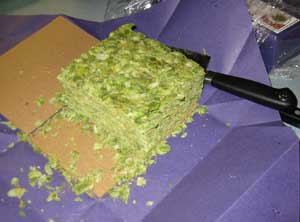
I bought a vacuum sealer yesterday so I could cut and bag my fresh hops without sacrificing their freshness to the freezer. The sealer I bought worked like a charm, and did an awesome job of compressing the hop packages. The most impressive part was how quickly I was able to slice up the 5 packages of hops and seal them in brewing quantities for later.
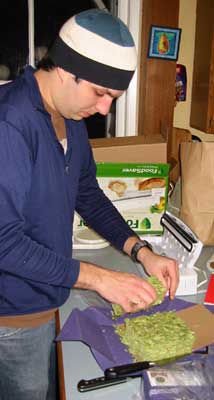
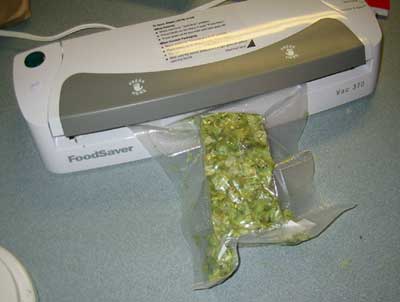
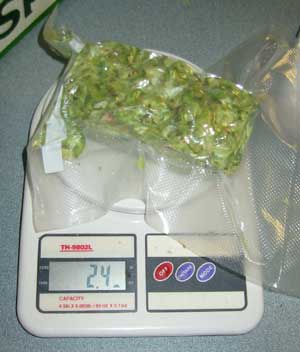
I smelled quite a few varieties last night, and Crystal was by far my favorite of the bunch. The aroma was stellar – citrus and pitch. I can’t wait to brew something special with them.
Today I brewed with an ounce of Galena for bittering and 2.2 oz of Fresh UK East Kent Goldings. I brewed a fairly traditional special bitter and used munich and British pale malt for flavor. The brew supply store didn’t have any Maris Otter.
Andy's Special Bitter and Flaked Barley Stout
I’ve added two new(er) recipes. Both should highlight the UK East Kent Golding’s that I got from my father-in-law for Christmas. One is Andy’s Special Bitter (ASB), the other Flaked Barley Stout.
For cost savings, I’m going to reuse the yeast cake. Naturally, I’ll be brewing the bitter first. Otherwise I might color and/or flavor pollute the bitter.
QBrew update missed
I totally missed the QBrew update from 0.3.3 to 0.3.4, but I’m hoping to make amends by posting a link to the update now. I love the program and use it for all my brews, including most of those in the recipe section.
I’ll have to try out the Mac version when I get home. I recently broke the QT installation on my desktop and have to rely on my laptop for recipes.
The Hop Bomb drops
My christmas gift from my father-in-law included a box full of hops. A mix of pellets, and whole cones too. I’m a little overwhelmed, and for the night I couldn’t really focus on what we were doing. All I could think about were recipes. Here’s why:
Whole cones:
- Galena – 13.2% α
- UK East Kent Goldings – 6.4% α (freshly imported)
- Santiam – 6.8% α
- Crystal – 3.9% α
- Vanguard – 4.4% α
- Nugget – 13.2% α
and for Pellets:
- Cascades – 5.7% α
- US Fuggle – 3.7% α
- Simcoe – 12.1% α
- Chinooks – 12.2% α
- Centennial – 10.0% α
- Palisades – 9.7% α
There are a couple I’ve never heard of, and one in particular makes me nervous. The Palisades are supposedly a new variety that could replace Willamettes. Willamettes are one of the most widely grown varieties here in the, uh, Willamette Valley, and the Palisade has a higher alpha acid content and a higher productivity, which could seriously hurt hop growers. Its one of those cases where the green revolution has surpassed its benefit to a large number of people and concentrated the benefit for one or two folks. You know who I’m talking about. The king of beers.
Regardless, I’m pretty damn excited because many of these hops will be very useful in expanding the variety of beer styles I can brew. I know Crystal and Galena to be favorites of Rogue, and there are several noble-style hops that rarely use.
Oddly enough – my coffee has taken on a distinctive hop flavor. Maybe I should move this box somewhere else.