Building a Mash Tun with a cooler

After some spectacular results using Scott’s cooler/mash tun, I’ve decided to build a mash/lauter tun from a 10 gallon Rubbermaid drink cooler and go all-grain. Joe and I brewed three great beers, and he’s done another couple that have turned out quite well. The quality of each of the beers seems to be as good or better than the best 10% of my extract and partial mash brews. Time to step up.

To start the process, I’ve been scouring the internet and print material on converting a cooler. I’ve been watching craigslist for some time hoping a 10 gallon drink cooler would pop up at the right price, but the only finds have been far enough out of the city that the savings over a new cooler are easily used up in travel and lost time. Luckily, Home Depot sells an orange HDPE lined cooler for $40. I opted for the cylindrical because John Palmer recommended them for 5 gallon batches, which is probably most of what I’ll be doing. There are lots of instructions out there on converting both a cylindrical and a rectangular cooler, which I’ve linked to at the bottom for reference.

I’ll be photo-documenting the process as well, but here are a number of conversions for comparison.

How-To Links

There are many more I’m sure, but this provides quite a variety to consider. I also checked a number of forums for opinions on false bottoms and manifolds. I’ll be going with a manifold design.
Where'd my beer go?

I bottled the Czech pilsner that Joe and I brewed some 2 months ago, and was disappointed that there were only 3 gallons worth of bottles (12x22oz, 10x12oz). I can’t remember how much we racked to primary fermentation, but I’m sure we lost a bit when we dry hopped in secondary (with 2+ oz of loose Czech hops), and maybe 1/2 gallon from all the trub after lagering.

I’m really curious if a hop back can give the flavor without loosing the volume. There has to be a more efficient way. What would the Germans do? (WWGD?)

In the cellar

Time has been short lately and with the prospect of moving, I scrounged in to my cellar and chilled an Imperial IPA that I brewed many moons ago. It was the last of the Yakistan Imperial IPAs. I’m pleased to say that:

  • Whoa!
  • There’s not much hopiness left, but…
  • damn.
  • the beer exhibits all the qualities I enjoy in a robust IIPIA – bitter, warm, malty, and, for lack of a better word, robusto.

You have to roll your R’s when you say that though. Really, I’m quite impressed with how it aged. Enough sugar, enough time, and I assume, the perfect cellaring conditions. Thank god we don’t have to move them though.

Lagering

I racked the pilsner that Joe & I brewed to the lagering vessel tonight. To avoid oxidization, I filled the carboy with CO2 first, then pushed the beer from secondary to the lagering carboy using CO2 as well. Seemed to work alright, though it’s sad to see only 4 gallons of the initial 5 make it this far. Maybe if I had dry hopped it in primary instead of secondary, we’d have both a clearer beer and a tad more available for labor day.

So I guess the lesson I learned from this batch was not to dry hop a lager with loose leaf hops. Pellets would have at least settled out.

Luckily, the beer tasted nice and had a nice color, though the turbidity was a little high. Hopefully a month or so lagering will solve some of that.

On the home front, we’ll be moving to NoPo to a place that has both an ideal garage and an ideal basement for brewing. Just have to choose. Given the lack of good pubs in the area, I may need to brew more.

Finally, a brew day

Scott, Joe and I were going to do a big brew day, but Scott had to go and get a job. However, Joe and my time constraints forced us to carry on and still brew today. We snagged Scott’s all grain gear, my kettle, and Joe’s new Zapap lautering setup and proceeded to brew a 10 gallon batch of ale that was split in to a Pale (or IPA… we’ll see) and an ESB, and a pilsner. I’d brewed with Scott doing some all grain, but didn’t know the specifics of what was going on, but luckily Joe, well, let’s just say he knows what he’s doing. Something about a formal brewing education…

Anyway, running two simultaneous all-grain batches wasn’t as bad as I thought it would be. The beers were all racked nicely, and all finished in the 1.050 – 1.060 range with few problems. There was something satisfying about brewing 15 gallons of beer, too.

The pale ale and ESB share the same base. We brewed 10 gallons of this basic recipe:

Grain

  • 18 lbs domestic 2-row
  • 2 lbs Crystal 40L
  • 1 lbs Munich

Hops

  • 1 oz Palisades (9.7% aa) @ 60
  • 1 oz Chinook (12.5% aa) @ 60min
  • 0.9 oz Chinook (12.5% aa) @ 30 min
  • 2 oz Cascade (6.9% aa) @ 5 min

The pale will get dry hopped in secondary with Cascades. The ESB was alloyed with a tea we brewed using 3 oz of Crystal 60L and 2oz of Chocolate malt, and a small addition of hops

The pils was brewed with the following

Grain

  • 7 lbs of Pilsner malt
  • 2 lbs of domestic 2-row
  • 1 lbs of CaraPils

Hops

  • 2 oz Czech Saaz (3.3% aa) @ 60
  • 2 oz Czech Saaz (3.3% aa) @ 10
  • 2 oz Czech Saaz (3.3% aa) @ 5
  • 2 oz Czech Saaz (3.3% aa) @ dryhop

The pale and ESB were both pitched with an ale yeast from Joe’s place of work, and the Pils with a lager yeast. We already have krausen too.

Brewing all grain with Joe was slightly different than brewing with Scott. Scott knows his equipment, knows the process, and has his thermometer calibrated. Joe and I were a little more trial and error. However, this was our first unguided experience, so we both agreed that it would be largely a learning experience and we’d worry about some of the other details later. All throughout the process, Joe would point out things like “there are two schools of thought on this” and we’d quickly debate or simply default on a position before moving on to the next step. Style is largely formed on limitations.

A few lessons learned from this experience:

  1. Bazooka screens clog way to easily with pelletized hops
  2. Hand-milling 30 pounds of grain can take a while
  3. If mashing two separate batches, either mash them side-by-side, or bring two thermometers.
  4. Brewing on a lovely day is no better and no worse than doing anything else on a lovely day.
  5. 10 gallons of wort is, like, twice as heavy as five gallons. Lift with the knees.

Chip clip returns

Chip clip returns

With two beers in secondary, it was time to clean out my kegs. I’d kind of been ignoring one of the kegs because of the chip clip incident. The keg was about 2/3 full and had gone bad quickly after tapping.

Anyway, after removing the ice (fridge was cold) and still good smelling beer, I found my chip clip at the bottom. It was kind of gross too. I’ve been using a stronger chip clip for the last two batches, but I suppose I should figure out a better system.

All grain 70/-

3 tier system?
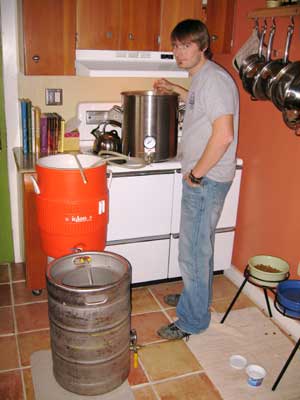
Scott brought over his new brew kettle and mash tun yesterday and we set up an ad-hoc 3-tier brewing system in my kitchen. We brewed a 10 gallon(ish) all-grain batch of Scottish 70 shilling. New equipment and new techniques slow things down a little, and this was not different. We did manage to brew the beer in just under 7 hours, though.

Scott modified a recipe we found on TasteyBrew for 10 gallons and for the hops we had on hand (I hate Northern Brewer… for no good reason) and I fired up a starter using Safale S-04. The sparge wen alright, though the wort gravity on the sparge was a little lower than expected. We deliberated and decided to stop a bit short of 10 gallons.

The boil went fairly well though there was a surprising amount of hot break, and the steam coming off the wort made it difficult to see the wort. Ultimately, we racked off around 8.5-9 gallons of beer with on O.G. of 1.036. While waiting for the boil we stood out in the cold, drank some brew, and discussed what techniques have improved our results the most and what challenges we want to take on next. Anyway, here’s the recipe.

Grain bill:

  • 15 lbs domestic 2-row
  • 1.0 lbs British Crystal 70/80L
  • 2.0 lbs German Munich
  • 0.5 lbs Roasted Barley

Hops:

  • 1 oz Chinook @ 60 min. (12.2% aa)
  • 2 oz U.S. Fuggles @ 5 min. (3.4% aa)

Misc:

  • Fermentis Safale S-04 dry yeast (with 1 liter starter)
  • Irish Moss

We joked about how much of the process is now second nature that we fail to include any instructions with our recipes. If you’re curious about the process, um… see a book or something.