The Younger

Tonight I headed out to Belmont Station
with Curtis for the primary reason of trying Pliny the Younger on tap. BS had a number of big IPAs on tap, but none quite scorched my palate with such deliciousness as Pliny.the place was surprisingly full when we met up with his friends, so we grabbed a glass of the bitter and stood in the adjacent bottle store and talked beer. We tried a few more; a black IPA from Bend Brewing that was dark, smooth and delicious and Fort George’s Chapel X-something that was just brilliant.

It’s been since May since I was at Belmont Station last, and their selection has improved beyond it’s already absurd state. I picked out a number of bottles I thought my bride might enjoy but ended up leaving lots on the shelves for another time.

update: While I was tempted to update in the middle of the night (I was up several times – I have a 7 week old), I found that each of my belches tasted so hoppy as to have a IBU that placed them outside any BJCP style guidelines. I’m not sure how Pliny the Younger can be so packed, but I can’t help but think maybe the beer has some actual lupalin dust off the kiln from some drying facility.

Visiting Oakshire Brewery

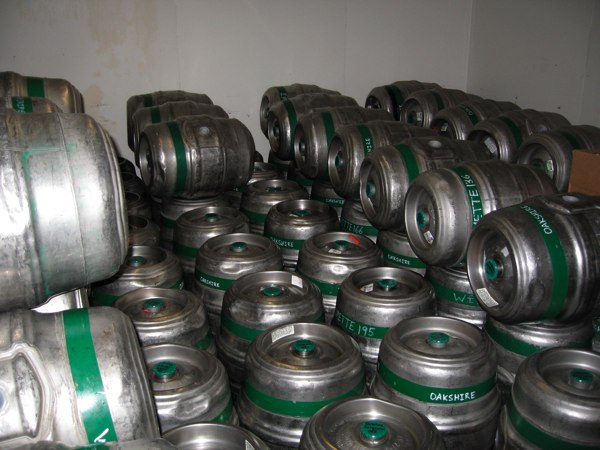
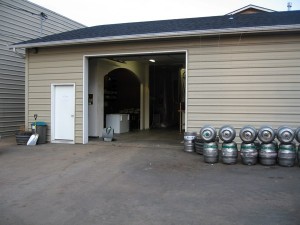
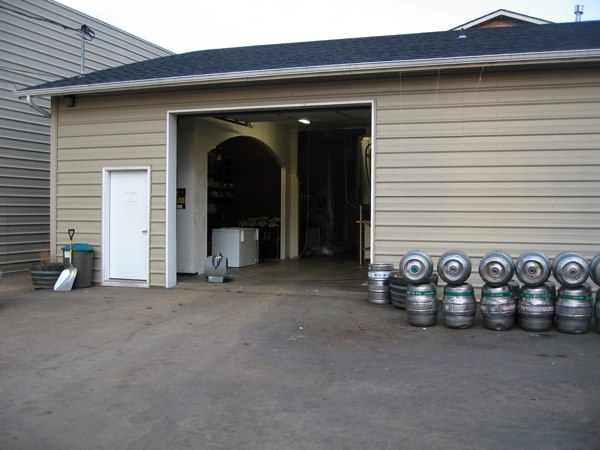
Ella and I were down in Eugene last Friday and were lucky enough to get a private tour of Oakshire Brewery from the head brewer, uncle Joe. The brewery is located in a light industrial area next to the train yard, which Ella pointed out over and over. The only clue that it was a brewery was the stack of kegs in front, otherwise, it looked like the other surrounding businesses. When we arrived, it was shortly before closing on Friday night. The garage door was open and a fellow my age was mopping the floor to clean up dirt that had been tracked in by a bobcat moving through the brewery to what would become the cellar. The man, Chris Althouse, happens to be one of the founders putting in his time at his brewery.
Oakshire Brewery

Joe poured me a sample of the wheat and Ella and I watched and explored as he finished up work for the day. The wheat (beer) is filtered, and has all the trappings of a summer beer; clean, bready and refreshing. Though filtered, it doesn’t lose the interest you might expect.

The brewery is about to change, but the current configuration is a single mash/lauter tun, single kettle, 4 fermenters, 1 bright tank and a cooler for cellaring. I’ve forgotten the volumes of each, though I’d guess the fermenters are ~20BBL and the kettle is under 10BBL. Hopefully Joe can correct me on these.
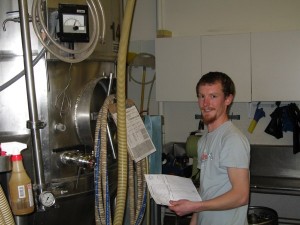
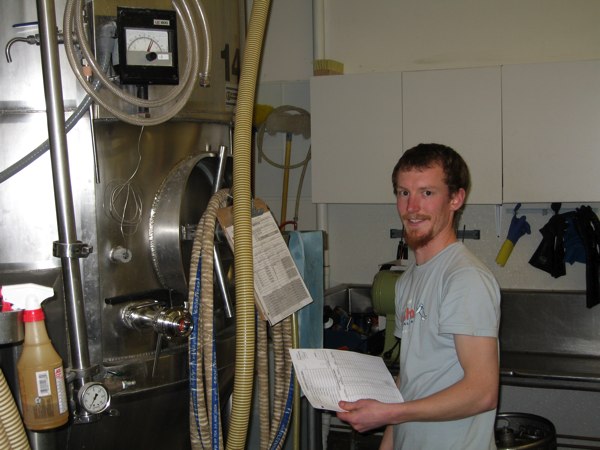
Joe monitoring fermentation

Joe poured me a sample of the Amber, which surprised me at first. I’ve grown accustomed to hoppy or sweet (and frankly boring) ambers and this is a departure from that. It’s delicious though – toasty and malty and just enough roast to remind you of a Scottish. I’d really like to try it again, so hopefully I can figure out where Point Blank distributes the beers here in Portland.
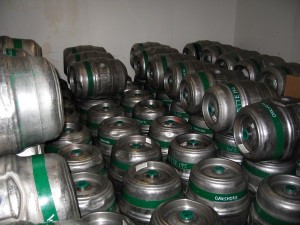
Cellar

The brewery has remnants of the proprietors’ home brew days. Old Sankey keg conversions have been repurposed for cleaning and sanitizing. As we talk about the various equipment, Chris mentions which parts they hope to upgrade soon and it is clear that a lot of thought has gone in to the brewery and to the direction they’d like to take it.

Next I tried the IPA, a beer I’d sampled at a festival in the past. It has a malt body that’s a little more old world, but the hops clearly have a northwest pedigree. The hop bill might change given the market, but if my memory is correct, it’s Centennial and Cascade for the aromatics and some Amarillo and Simcoe for dry hop. I want to say that Chinook was the bittering for all the beers, but it may have been Columbus. The IPA is a solid beer which Joe is happy about, comparing it to the IPA from some of his past jobs. I agree with him – it’s very drinkable and is a mouthful of the things I like in an IPA.

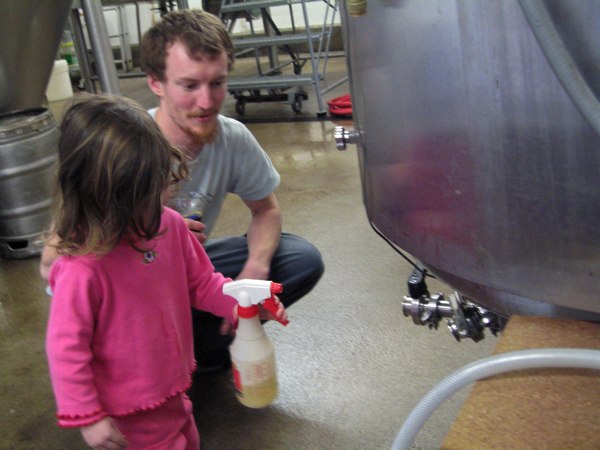
The last sample is of the coffee stout which Joe draws off the bright tank. Ella helps him sanitize the outlet afterwards, keeping the beer safe. It hasn’t fully carbonated yet, but that isn’t a detriment to the beer. I remember this beer fondly from a past festival. Cold-pressed coffee and chocolaty roasted barley make for a smooth and delicious beer. Despite being winter, I’ve had a limited intake of stouts this season, but this one is great. There’s no harsh bitterness from the coffee. I really recommend finding this one on tap somewhere soon.
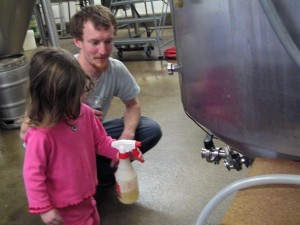
Ella helps keep clean

While finishing this last sample, Jeff, the other co-founder shows up and the two brothers catch up on the construction progress, the plans for the weekend, and sample some of the IPA. It’s clear from their mood and from the beers themselves that things are going well and that the future is promising. Joe is an excellent addition to the brewery and I expect he’ll only help make things better. He brings a wealth of knowledge and experience as well as a calm demeanor and strong set of problem solving skills that are necessary in the brewhouse. Since I’m a friend of his, take from these comments what you will, but I think you’ll find the proof in the puddin’.

Oooh… tapioca beer. That’d be like petrified carbonation. I’m going to call dibs on that, even though it’s sounding less and less appetizing as I think about it.
Editorial on Oregon Beer Tax

Irene Firmat of Full Sail Brewing and Gary Fish of Deschutes Brewing have an editorial in today’s Oregonian regarding the proposed beer tax. They highlight the production side aspect of the tax, something that is often misunderstood. While I wouldn’t mind paying for many of the services this tax is trying to address, this isn’t how I’d choose to do it. It hurts my dear Oregon breweries.

Death knell for Willamette hops

I received word from the Hop Growers of America Conference that ABI (Anhuesher-Busch InBev) is going to stop using whole hops in their product and start using extracts. Additionally, they are going to stop using Willamettes, something they have spent the last year and a half touting on billboards in our region. This could have some major ramifications for local growers (who are being paid not to grow the varietal) as there are some limitations on what can be grown here because of susceptibility to downy mildews (guess what, it’s wet here.)

At the risk of sounding jaded, I wonder how many other long standing traditions AB will change now that they kowtow to an even larger number of shareholders. Will they stop using clydesdales and start using goats to save on stable an feed costs? It’s unlikely they’ll change anything related to marketing, since that is all their beers are. I shouldn’t care if they use hop oil extracts and pellets if the beer is the same, but they have claimed the opposite for so long.

I’m going to predict the rise of Bravo hops. It’s a high yield, high alpha varietal that has good downy resistance. Sure, we’ve already got a lot of Nugget being grown here, but Bravo has a higher alpha potential and a higher yield. We’ll just have to see what restrictions have been placed on growers this year.

MadelIPA tapped, rocks the house

I tapped the keg of MadelIPA last night and I’m pleased to report that it f*@%ing rocks. I made a few changes, including dry hopping the keg with 2 ounces of Santiam hops. It added a nice mellow but citrusy and very complimentary throat to the beer. Given it’s significant bittering, it’s a welcome addition. The 134 IBU aren’t apparent now, unlike the painful bitterness that existed when I sampled between primary and secondary fermentation, but it’s still a bitter beer.

Thinking about tiers

My last couple brew days have included a weird shuffling ritual about half-way through lautering where my sweet wort kettle is nearly full and my hot liquor tank (also my brew kettle) still have hot water that needs to go in to the lauter. What ensues is a silly, high risk game of musical pots as I pour liquids between 4-5 different kettles and stock pots trying to get all the hot water from my main brew kettle so I can collect the remaining sweet wort.

Another method I’d like to leave behind is the constant ladling and scooping from the hot liquor tank and pouring it in to the mash tun. I’m afraid I’ll mess up the grain bed. I think I’m going to have to build myself a 2 tier rack so that I can harvest gravity’s natural talent in making water go downhill. Luckily, there’s lots of examples for ideas at Brewhalla.

Now I’m just mentally building it. And watching craigslist for potential kettles and parts.

MadelIPA brew day recap

I brewed a re-modified version of MadelIPA on Saturday and had to make some on the fly changes. My last brew day had 95-100% humidity, so the amount of evaporation was nearly nothing, leaving me with a slightly more dilute beer than I’d planned. This time I wasn’t going to be caught off guard, so I lautered a larger volume than the 6 gallons called for, and since the gravity of the sweet wort was still in range, I figured no harm would be done. But after mixing the sweet wort, I took a gravity reading and found it to be near 1.040, lower than I was expecting, even with evaporation.

What to do? Turn the recipe in to a 90 minute boil, add some corn sugar and add more hops of course. Adding hops was a no brainer, but the corn sugar? Well, I had 3/4 lbs of it on hand, and a Pliny clone I found called for it, so I figured it was a safe way to up the OG without changing the body or flavor (hopefully). All said and done, the brew went well. I hit my strike tempurature just right so my mash temperature was spot on 152F.

Now the beer is sitting in primary bubbling, though krausen came on slowly. Not to get all finger-pointy, but I was using my first activator pack, and fermentation didn’t start until nearly 12 hours after pitching. That’s the price I pay for not having a starter on hand. I probably should have just dropped the dry yeast in.

Oh, and the extra hops were a good idea, at least for aroma’s sake. My basement smells delicious.

No IPA

No IPA sticker in my iMac
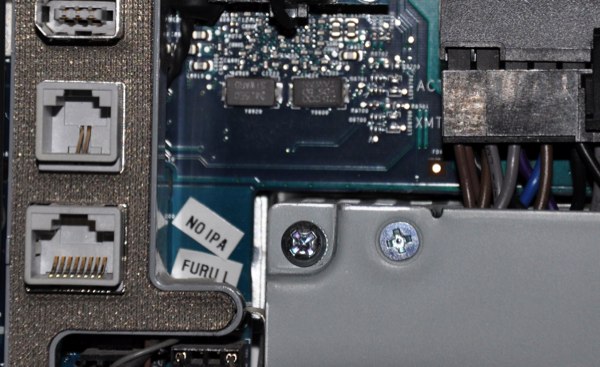
Last night I cracked open my iMac to add a new hard drive. One of the first things I noticed (other than how nice the industrial design is) was a sticker stating “NO IPA.” I’m not sure if this means I shouldn’t drink while working on computers, or shouldn’t give my computer bitter ale, or if it is an acronym for something else, but I didn’t much care for the tone. I’ll be the one who decides when there is No IPA.

Hop Inventory for 2009

My “inside guy” has again procured a bundle of hops for me as a Christmas present. This year’s bundle includes some varieties I’ve not used before as well, so I’ll be doing some reading to figure out what each is suited for. Here’s the haul, and a few notes from both the Hop Union Variety Databook, and for my own use.

Believe it or not, I will refer to this post over and over for alpha acid and variety notes throughout the year. It’s not just to gloat.

Whole hops:

  • Newport 11.2% alpha – Bittering hop similar to Galena and Nugget. Good base for ales.
  • Nugget 14.4% alpha – High-alpha bittering hop with grassy, herbal aroma. Good base for ales.

Pellets

  • US Perle 7.5% – Dual purpose aromatic and bittering. Used in German-style brews, both ales and lagers.
  • Crystal 4.3% – Very aromatic Hallertau relative. Wonderful smells. Great for Continental brews.
  • Brewers Gold 9.3% – a spicy bittering hop.
  • Vanguard 5.0% – Similar to Hallertau, good for German beers, both ales and lagers.
  • Cascade 7.8% – Duh…Citrusy and floral aromatic. Taste of the NW.
  • Palisades 8.0% – Still undecided. Seem to be more of a bittering hop than an aroma. Not the most pleasant aroma, so don’t use for single hopped beers.
  • US Goldings 4.9% – US relative of Kent Golding, a versatile aromatic hop used in everything from bitters to stouts.
  • Millennium 15.9% – high alpha relative of Nugget with similar aroma.